

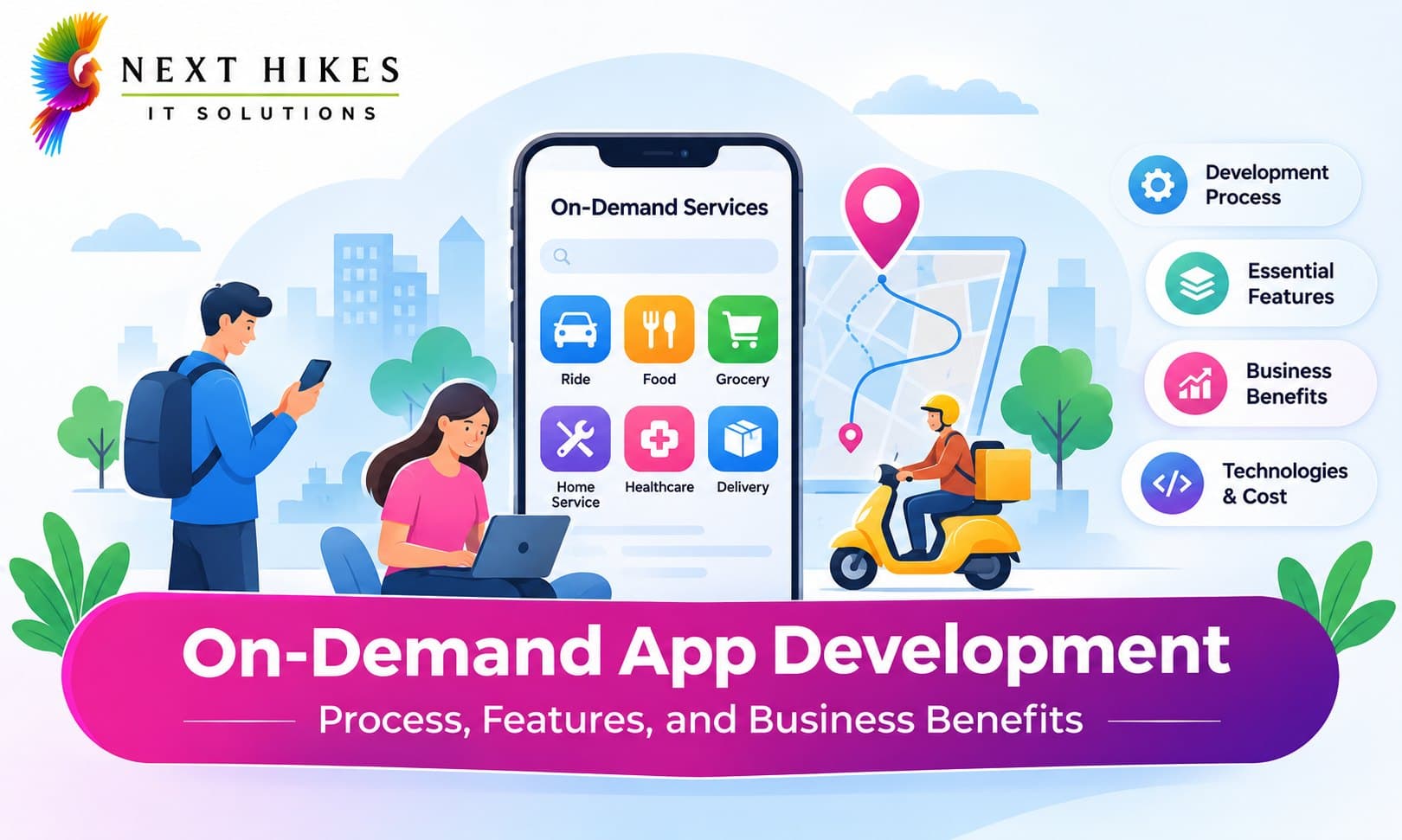
On-Demand App Development: Process, Features, and Business Benefits
Why On-Demand Apps Matter for Businesses
It is 7 p.m., and a customer needs a plumber, a cab, or tomorrow's groceries. She opens an app, compares options, books in under a minute, and watches the provider approach on a live map. Payment happens in the same app, with no cash involved.
Customers now expect this level of convenience from nearly every service. On-demand app development gives businesses a way to meet that expectation by building a digital platform that connects customers with service providers in real time. Whether you run a local service business or plan to launch a marketplace, the right app replaces scattered phone calls and manual scheduling with a smooth, trackable experience. This guide covers the process, features, technologies, costs, and benefits you should understand before you start.
What Is On-Demand App Development?
On-demand app development is the process of designing, building, and launching mobile or web applications that deliver services or products the moment a customer asks for them. These apps sit between three parties: customers who need something, providers who can supply it, and the business or platform that manages the exchange. Behind the scenes, the application handles matching, scheduling, payments, communication, and reporting.
How Do On-Demand Applications Work?
Most platforms follow the same workflow: Customer Request → Provider Matching → Booking Confirmation → Service Delivery → Payment → Customer Feedback. A customer submits a request, the system finds a suitable available provider, and both sides receive confirmation. The provider completes the job, payment is processed in the app, and the customer leaves a rating.
On-Demand Apps vs Traditional Service Models
Traditional models depend on phone calls, fixed office hours, and manual dispatch. An on-demand service app replaces that with self-service booking, live status updates, and automated records. Businesses also gain data on demand patterns, which is hard to collect offline.
Types of On-Demand Applications
The model works across many industries. Here are the most common categories, with familiar platforms as illustrations.
Food and Grocery Delivery Apps
Customers browse menus or catalogs, place orders, and track delivery. DoorDash is a well-known example of this model. Restaurants and stores manage orders while the platform coordinates delivery partners.
Ride-Hailing and Transportation Apps
Apps such as Uber connect riders with nearby drivers. Fare estimates and live trip tracking sit at the center of the experience.
Home Service Booking Apps
Cleaning, repairs, beauty services, and appliance maintenance fit this model well. Urban Company is a commonly cited example, where customers book professionals for a chosen time slot.
Healthcare and Telemedicine Apps
Patients book appointments, consult doctors by video, and receive reports digitally. These apps need extra attention to privacy and regulatory compliance.
Logistics and Courier Delivery Apps
Businesses and individuals schedule pickups, track parcels, and confirm delivery. Route handling and driver management are the main technical concerns.
Business Benefits of On-Demand App Development
Improved Customer Convenience and Accessibility
A salon that takes bookings only by phone loses customers who call after hours. An app lets people book at midnight, choose a stylist, and reschedule without waiting on hold.
Automated Booking and Service Management
Automatic matching, reminders, and invoicing cut down manual coordination. A cleaning company, for example, can assign jobs by location and availability instead of juggling spreadsheets and messages.
Better Customer Engagement and Retention
Push notifications, saved addresses, and order history make repeat bookings effortless. Ratings and reviews also show exactly where service quality needs attention.
New Revenue and Business Expansion Opportunities
Apps open up revenue models such as commissions, subscriptions, premium listings, and delivery fees. They also let a business enter new neighborhoods or service categories without opening physical branches.
Step-by-Step On-Demand App Development Process
A clear on-demand app development process keeps scope, budget, and timelines under control. Here is how it typically unfolds.
Step 1 – Define Business Goals and Target Audience
Start with the problem. Which service are you digitizing, who needs it, and what does success look like? Defining customer segments, service categories, and measurable goals, such as monthly bookings or provider sign-ups, stops the team from building features nobody asked for.
Step 2 – Conduct Market Research and Competitor Analysis
Study existing apps in your category. Read their reviews, note what users complain about, and look for gaps in pricing, coverage, or experience. This research shows whether demand exists in your target area and where you can stand out.
Step 3 – Select the Business Model and Core App Features
Decide how the platform will earn money: commission, subscription, or service fees. Then list requirements for customers, providers, and administrators, and separate must-have features from nice-to-have ones. The result is your minimum viable product (MVP), the smallest version that delivers real value.
Step 4 – Design UI/UX and User Journeys
Designers map how each user moves through the app, from sign-up to payment. Wireframes and clickable prototypes let you test navigation before developers write code. Fixing a confusing booking flow at this stage costs far less than fixing it after launch.
Step 5 – Choose the Right Technology Stack
Select frontend frameworks, backend languages, databases, and cloud hosting based on performance needs, expected user volume, and budget. Also decide which third-party services will handle maps, payments, and messaging.
Step 6 – Develop the MVP and Integrate Essential Services
Developers build the customer app, provider app, and admin panel, along with the backend and APIs that connect them. Core integrations usually include payment gateways, map and location services, push notifications, and the booking engine. Working in short sprints with regular demos keeps the project transparent.
Step 7 – Test App Functionality, Security, and Performance
Testers check every workflow: booking, cancellation, refunds, and notifications. They also run usability sessions with real users, verify payment flows, scan for security weaknesses, and simulate heavy traffic to see how the system behaves under load.
Step 8 – Launch, Monitor, and Maintain the Application
Deploy the backend, publish the apps to the App Store and Google Play where applicable, and monitor crashes, response times, and user behavior. Post-launch feedback guides bug fixes, updates, and new features, while scalable infrastructure lets the platform grow with demand.
Essential Features of an On-Demand App
Every on-demand platform rests on three connected parts: a customer app, a provider app, and an admin dashboard.
Customer App Features
- User registration and login
- Service search and booking
- Real-time order or service tracking
- Online payments
- Push notifications
- Ratings and reviews
Service Provider App Features
- Provider registration and verification
- Service request management
- Availability management
- Booking acceptance and rejection
- Earnings and transaction history
Admin Dashboard Features
- Customer and provider management
- Booking and order monitoring
- Payment management
- Analytics and reporting
- Service management
Advanced Features and Third-Party Integrations
The features above form a solid MVP. Optional additions include AI-based recommendations, in-app chat, advanced GPS routing, loyalty programs, and integrations with accounting or CRM tools. Add these after launch, once real usage shows which ones matter.
Technologies Used in On-Demand App Development
There is no single best stack. The right choice depends on project requirements, performance, scalability, budget, and your team's expertise.
Frontend and Cross-Platform Technologies
Flutter and React Native let one codebase serve both Android and iOS, which saves time and cost. Kotlin (Android) and Swift (iOS) suit apps that need the best native performance.
Backend, Database, and Cloud Infrastructure
Node.js, Python, and Java are common backend choices. PostgreSQL and MySQL handle structured data such as bookings, while MongoDB and Firebase suit flexible or real-time data. AWS, Microsoft Azure, and Google Cloud provide scalable hosting.
Payment, Maps, and Notification Integrations
REST APIs connect the app with outside services: payment gateways for transactions, Google Maps APIs for location and routes, and push notification services for alerts.
How Much Does On-Demand App Development Cost?
No single figure fits every project, so this guide does not quote a fixed price. Cost depends on scope, and a reliable estimate is possible only after requirements are defined.
Key Factors Affecting Development Cost
- Number of application interfaces (customer, provider, admin)
- Feature complexity
- UI/UX design requirements
- Backend infrastructure
- Third-party integrations
- Security and compliance requirements
- Development team size and location
- Hosting and maintenance
MVP vs Full-Featured On-Demand App
An MVP with core booking, payment, and tracking reaches the market sooner and costs less than a full-featured platform with advanced modules. Starting small lets you validate demand before committing a larger budget.
Maintenance and Ongoing Operational Costs
Plan for hosting, third-party API fees, bug fixes, operating system updates, security patches, and customer support after launch. Ask any vendor for a written estimate that lists its assumptions.
Common Challenges in On-Demand App Development
Real-Time Tracking and Performance
Live GPS updates can strain servers and drain device batteries. Sensible update intervals, reliable cloud infrastructure, and load testing keep tracking accurate and responsive.
Payment Security and Data Privacy
Use trusted payment gateways instead of storing card data yourself, encrypt sensitive information, and follow the privacy regulations that apply in your market.
Service Provider Availability and Scalability
Too few providers means long waits. Verify providers carefully, offer fair incentives, and design a scalable architecture from the start so traffic spikes do not cause outages.
How to Choose an On-Demand App Development Company
The right partner combines relevant experience, technical skill, clear communication, and dependable support.
Review Relevant Experience and Portfolio
Look for similar projects and ask what role the team played in them.
Evaluate Technical Expertise and Security Practices
Ask about their stack, testing process, code reviews, and data protection methods.
Check Maintenance and Post-Launch Support
Confirm who handles updates, monitoring, and bug fixes after launch.

Harsh Gupta
Sr.Digital Marketing ExecutiveWith 3+ years of experience in digital marketing, specializes in SEO, social media marketing, paid campaigns, and brand growth strategies. Skilled in creating result-driven marketing campaigns that improve online visibility, audience engagement, and lead generation. Passionate about helping businesses grow through innovative digital solutions, performance marketing, and data-driven decision-making. Known for delivering creative strategies, strong communication, and measurable business results.
Related Articles
More from the world of App Development
Android vs iOS App Development: Which Should Businesses Choose?
Compare Android and iOS app development to understand their costs, features, security, and benefits. Discover which platform best suits your business goals and target audience.
 Harsh Gupta

Importance of UI/UX Design in the App Development Process
Better Apps Through Great UI/UX Design
Harsh GuptaDo You Have Any Questions?
Before launching any application or platform, there are always key questions to consider. Here are some of the most common ones we address.
An MVP often takes a few months, while a full-featured platform takes longer. Timelines depend on scope, integrations, and team size.